
Ryn here. Let me save you the confusion.
Binance is a crypto exchange. Think of it as a bank where people buy, sell, and park digital money like Bitcoin. Like any bank, it keeps some cash in the drawer so customers can withdraw whenever they want. In crypto, that drawer is called a hot wallet, and it’s connected to the internet so money can move fast. That convenience is also the weak spot.
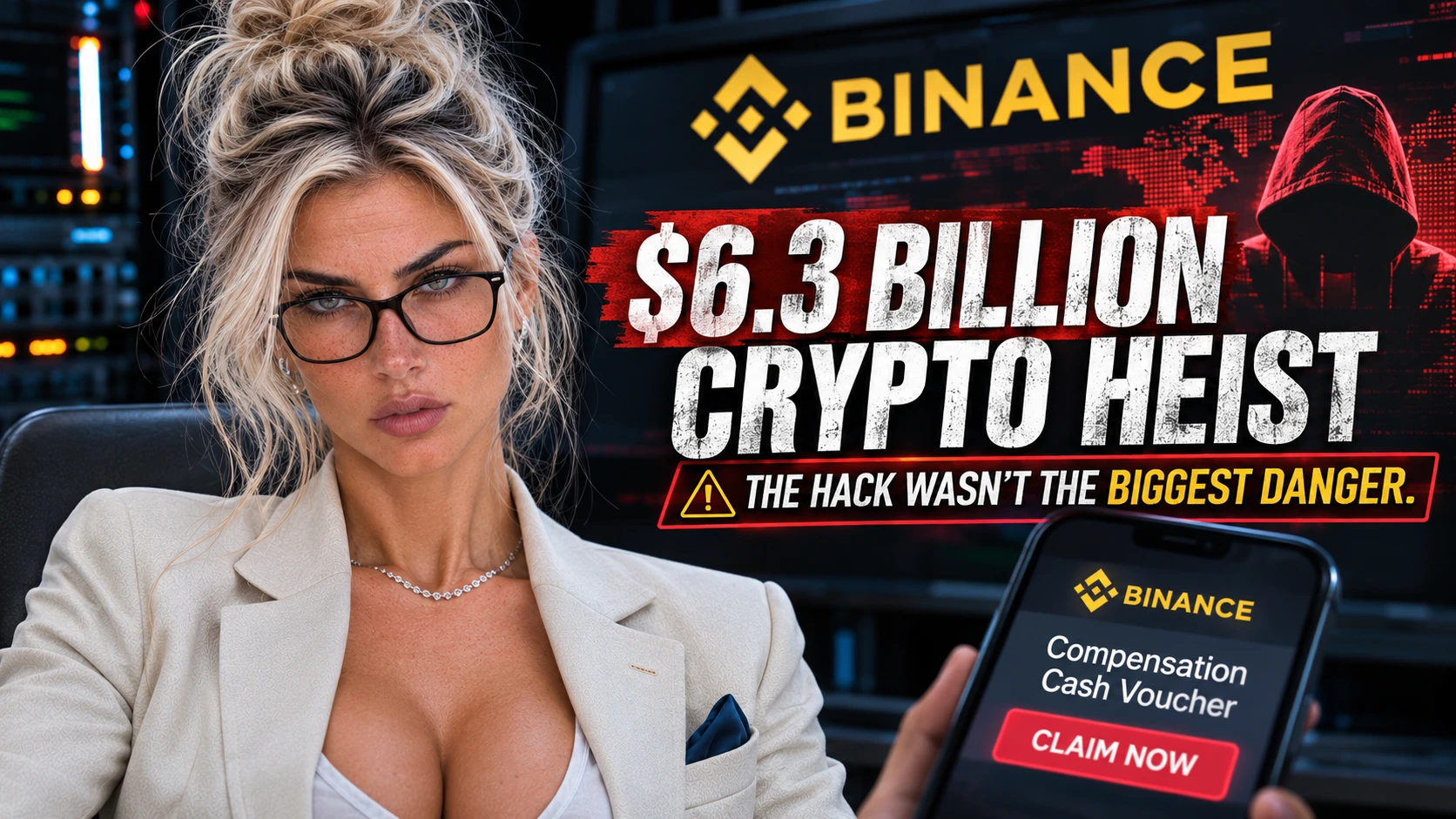
On October 29, thieves emptied a big chunk of that drawer. About $6.3 billion walked out across ten different blockchains, which makes it the biggest crypto theft anyone has recorded. Binance says it may have started with one employee’s laptop. The FBI says North Korea’s TraderTraitor group did it, so this was a government-backed crew of professional thieves, and they knew exactly which drawer to hit.
Binance says it’s covering every customer’s loss, and it reopened withdrawals on November 1. If you had money there, the exchange says it’s taking the hit. Hold that thought, because the hack was never the biggest danger to you.
The bigger danger showed up the next day. Scammers started sending fake “compensation” and “cash voucher” links dressed up as Binance, promising to make people whole. Binance’s own co-founder said there is no voucher program. The link exists for one reason: to get you to type in your login, your security code, or your seed phrase. That’s the secret list of words that unlocks your crypto, and whoever has it owns your money. Nobody has to hack you if they can get you to open the door yourself.
That’s how a heist you had nothing to do with becomes your drained wallet. The thieves hit Binance. The next round is coming for your inbox, your texts, and your Facebook feed, because that’s where people over 50 spend their time and where scam ads run all day.
Below, I’ll show you how these scams work, how to spot the fake rescue, and what to lock down this week. You’re not behind on crypto, and you’re not too old for this. You’ve just been walking around without the armor nobody handed you.
You are not broken. You are unarmed. Let’s fix that.
Ryn
Wallet Drained
A TikTok video crossed my desk a couple of weeks ago. Someone said their wallet had been drained and they’d lost everything. The video itself was short. The comments were the real story: 390 of them, most from strangers posting their own losses, one after another, like a support group nobody wanted to join.
A week later, on October 29, thieves pulled about $6.3 billion out of Binance, one of the biggest crypto exchanges in the world. One person on TikTok and a giant exchange look like two different stories. They end up in the same place, with a pile of strangers suddenly offering to help.
What Happened at Binance
Money started leaving Binance’s hot wallets on October 29 at around 8:05 p.m. UTC. The thieves hit wallets on ten different blockchains. Binance puts the loss at about $6.3 billion, and the blockchain tracking firm TRM Labs counts about $6.36 billion. Keep in mind that most of these numbers come from Binance itself, so treat them as Binance’s estimate until an outside review says otherwise.
Binance first said the break-in may have started with a compromised laptop belonging to an employee. Co-CEO Richard Teng later said the investigation found more points of entry and called it a more complex attack. He also said there’s no sign so far that the private keys to customer wallets leaked. On October 31, the FBI named North Korea’s TraderTraitor group as the thieves. Some outlets say that’s the same crew behind the 2025 Bybit theft.
Binance paused withdrawals early on October 30. The first round of withdrawals reopened on November 1.
Is Your Money Safe?
If your crypto was sitting on Binance, the company says you won’t lose it. It says it’s covering every loss, and it claims it has already replaced about 95% of what was stolen.
About $3 billion of the stolen money was frozen, mostly in USDT and USDC. Those are stablecoins, which are digital dollars run by companies that can lock funds when they’re flagged as stolen. Bitcoin, Ethereum, Solana, and XRP have no company in charge that can freeze them, and the thieves have kept moving those. Experts say money like that is hard to get back.
So for most Binance customers, the exchange is eating the loss. Your account is probably fine. Your inbox is another matter.
The Second Wave
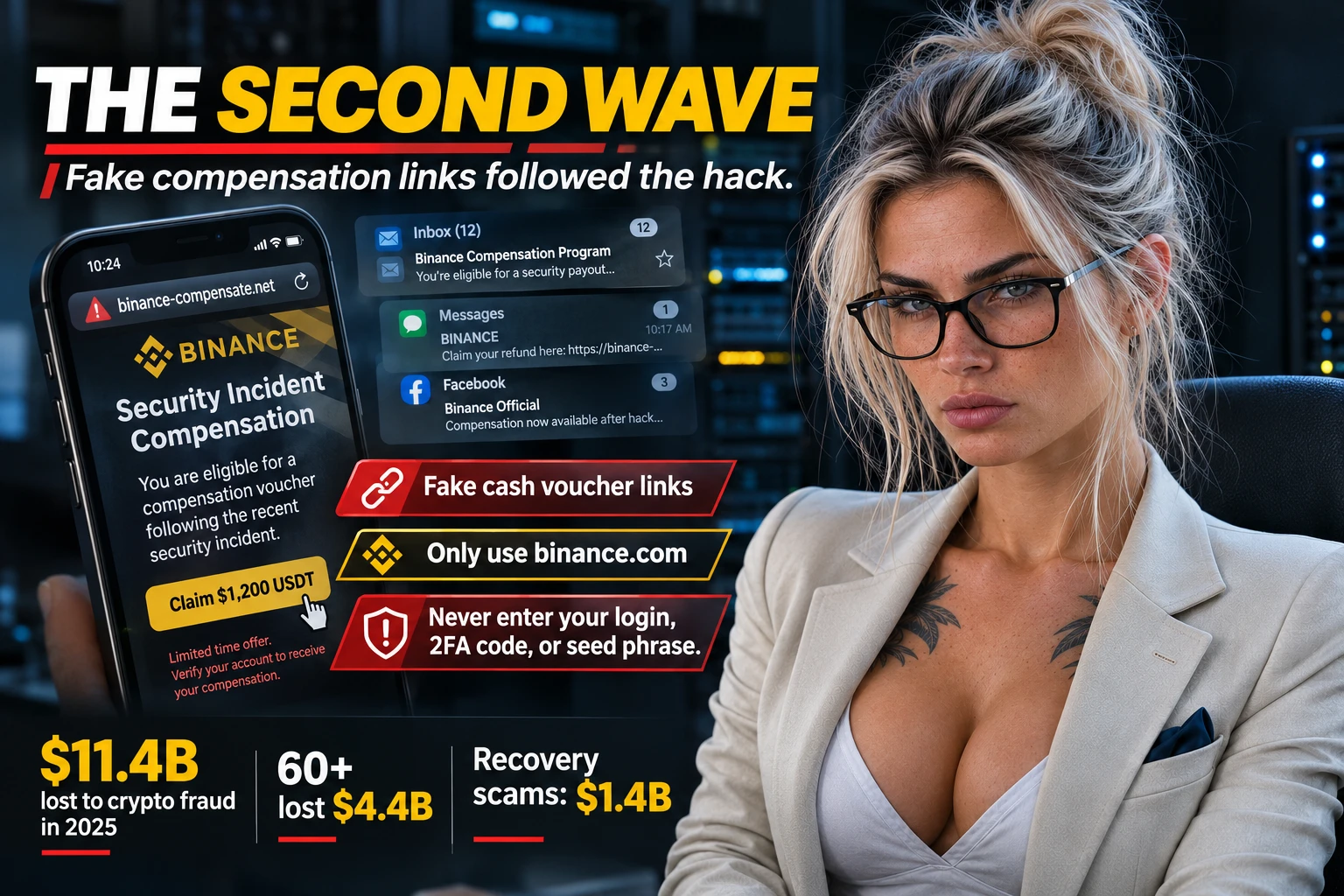
Right after the hack, fake “compensation” and “cash voucher” links started showing up. They looked like Binance. They promised refunds, bonuses, or make-good payments for the trouble. Binance co-founder Yi He told users to ignore them and said no cash voucher campaign exists.
Binance’s own warning was simple. Never type your login, your two-factor code, or your seed phrase into a link someone sends you. Only use binance.com and Binance’s official accounts.
Big news, worried customers, and a promise of free money make perfect bait. Scammers don’t need to break into Binance. They only need you to believe the email is from Binance.
Why the Scammers Want You
The FBI’s latest Internet Crime Report says Americans lost a record $11.4 billion to crypto fraud in 2025. People 60 and older lost $4.4 billion of that, across more than 44,000 complaints. Crypto ATMs alone took $257 million from people over 60.
One category should get your attention after a big hack: recovery scams. Those are the people who promise to get your stolen money back, for a fee. Across all ages, they took $1.4 billion in 2025. They show up after every disaster, because a person who just lost money will listen to anyone offering to return it.
Then there’s where the bait gets delivered. In November 2025, Reuters reported on internal Meta documents that projected about 10% of the company’s 2024 revenue, roughly $16 billion, would come from ads for scams and banned goods. One document estimated Meta showed users about 15 billion higher-risk scam ads a day. Meta told Reuters the 10% figure was a rough and overly inclusive estimate. Either way, if you’re on Facebook, the fake voucher link has a good chance of finding you there.
How a Wallet Actually Gets Drained
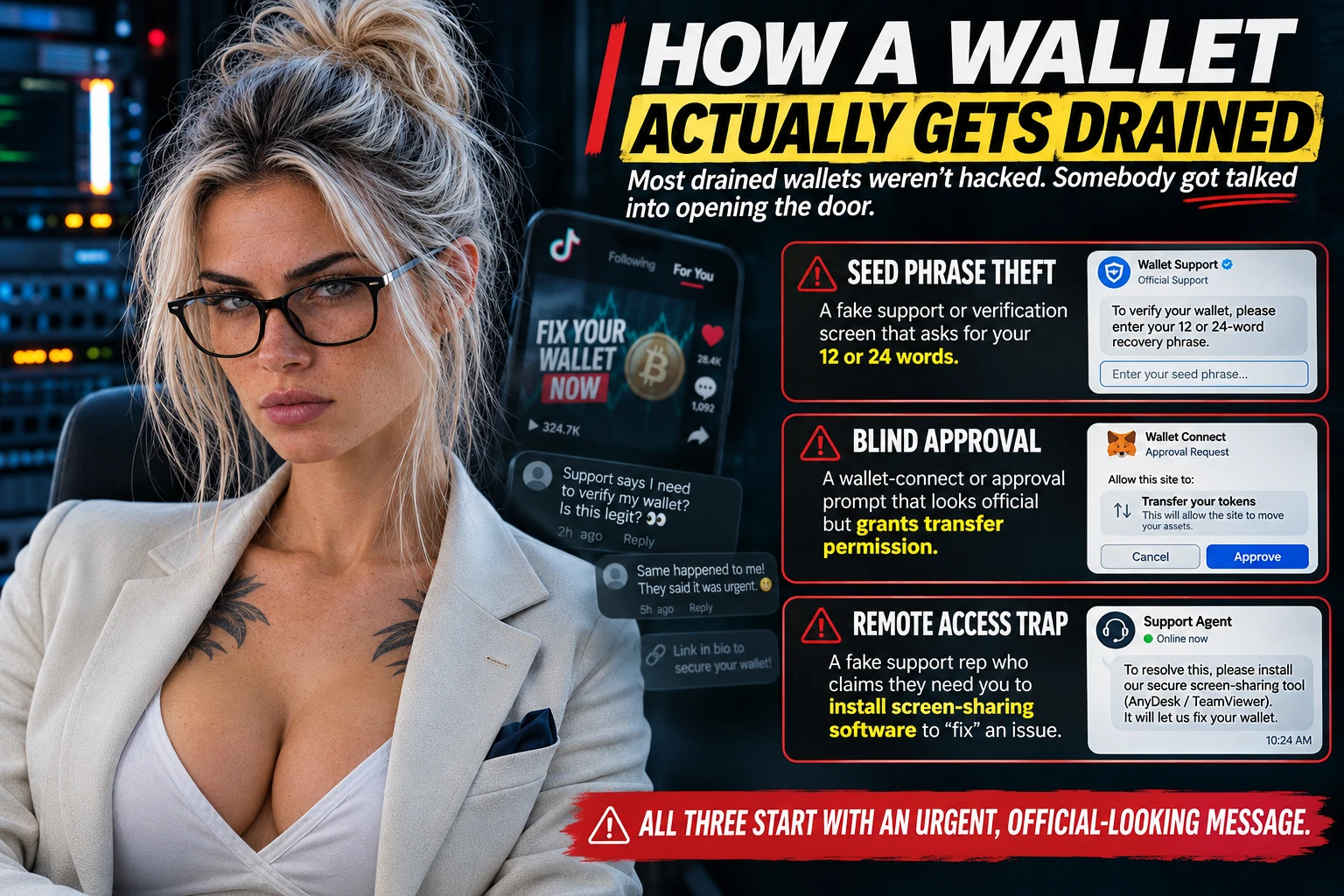
Most drained wallets weren’t hacked in the movie sense. Somebody got talked into opening the door.
The most common way is the seed phrase. That’s the list of 12 or 24 words you got when you set up your wallet. Anyone who has those words owns everything in it, and no one can undo it. A fake support agent, a fake “verify your wallet” page, or a fake refund form asks for the words, and the money is gone within minutes.
The second way is signing something you didn’t read. You land on a site that looks official, connect your wallet, and click “approve.” That approval can give a stranger permission to move your coins. The page looked fine. The permission was the trap.
The third way is letting someone into your computer. A “support rep” asks you to install a screen-sharing app so they can help. Once they’re in, they’re in your wallet too.
All three start with a message that feels urgent and official. That’s the person in the TikTok comments, over and over.
What to Do This Week
Bookmark the real website for any exchange you use, and only log in from that bookmark. Never click a login link in an email, text, or ad, even when it looks right.
Write this down and tape it to your monitor: no real company will ever ask for your seed phrase. Not Binance, not your wallet maker, not a support agent, not a government agency. Anyone who asks is a thief.
Ignore every message about compensation, refunds, vouchers, or recovering lost funds. If you lost money, the only people who can help are the exchange through its official site and law enforcement. Anyone else who promises to get it back for a fee is the second scam.
Move what you’re not actively trading off the exchange and into a hardware wallet you control. It’s a small device that keeps your keys offline, so a hacked exchange or a fake link can’t reach them. Start with our Ledger Nano X review and Trezor Model T review.
If you already got hit, report it to the FBI at ic3.gov, and don’t pay anyone to “recover” it.
The Fix Nobody’s Talking About
Every one of these scams works for the same reason. You can’t prove who’s on the other end. The fake Binance email, the fake support agent, and the fake recovery service all win because a logo and a friendly tone are easy to copy.
That’s the case Web3Rescued keeps making for decentralized identity. When a company or a person can prove who they are with an identity they own and nobody can forge, the fake voucher link stops working, because it can’t prove it came from Binance. We’re not there yet. That’s why your bookmark, your seed phrase, and your skepticism are your armor today. If you want the bigger picture, read Stop Renting Your Own Name.
The Bottom Line
The heist was Binance’s problem. The follow-up is yours. Bookmark the real site tonight, hide your seed phrase where no screen can see it, and treat every “we owe you money” message as a thief knocking.
New to any of this? Start with our Glossary of Web3, then pick a wallet from our reviews and get your coins off the exchange.
Sources
- Binance Hack: Everything We Know About the $6.3B Theft (StealthEX)
- Binance responds to $6 billion crypto hack after claims a single laptop was to blame (Dexerto)
- FBI says crypto-related fraud losses hit record $11.4 billion in 2025 (The Block)
- Meta projected 10% of its 2024 revenue would come from scam ads (SAN, citing Reuters)
- FBI Internet Crime Complaint Center